
Top 10 Kitchen Sink Double Bowl Types for Global Buyers

Choosing the right Kitchen Sink Double bowl design is no longer a simple matter of size or price. Global buyers now compare workflow, material performance, installation method, water use, and after-sales reliability. A sink may look impressive in a showroom, yet feel cramped when a large roasting pan blocks both bowls. That practical gap matters.

Recent industry research supports this shift toward functional kitchen planning. The National Kitchen & Bath Association’s 2024 Kitchen Trends Report highlights convenience, durable materials, and improved workspace organization as important design priorities. Houzz’s 2024 U.S. Kitchen Trends Study also shows continued interest in upgraded kitchen fixtures and practical renovation features. These findings suggest that buyers want more than attractive stainless steel. They want quieter bowls, easy-clean corners, usable depth, and dependable drainage.

The following guide examines ten Kitchen Sink Double bowl types for international buyers. It considers stainless steel, granite composite, fireclay, ceramic, workstation, low-divider, and farmhouse configurations. Each type creates a different daily experience. One design may separate food preparation efficiently. Another may offer better clearance for wide cookware. Some are ideal for compact apartments. Others require reinforced cabinetry and careful countertop planning.

Small details decide satisfaction.

However, no global ranking can fit every market. Cabinet standards, plumbing layouts, water pressure, cooking habits, and local installer skills vary widely. A low-divider sink may suit one household but create splash problems in another. This guide therefore combines product knowledge, trade-oriented evaluation, and realistic limitations. Buyers should verify dimensions, certifications, warranty terms, and replacement-part access before ordering. Performance matters. So does what happens after installation.
Top 10 Kitchen Sink Double Bowl Types for Global Buyers

Double Bowl Kitchen Sink Basics and Global Buyer Considerations

A double bowl kitchen sink separates washing, rinsing, soaking, or food preparation. Equal bowls offer balanced use, while unequal bowls suit large pans and smaller daily tasks. Low-divider designs create more working space but may allow water to cross between bowls. Offset, corner, farmhouse-style, undermount, and top-mount versions serve different cabinet layouts and installation preferences.

For global buyers, measure the cabinet opening, countertop depth, drain position, and available plumbing space before choosing a model. Bowl depth matters. A deeper bowl is not always better, especially for users with limited reach. Stainless steel is durable and easy to maintain, while granite composite can reduce noise and provide a solid appearance. Ceramic surfaces look clean but may chip under heavy impact. Check material thickness, drainage slope, overflow design, and included mounting parts.

Practical details often decide satisfaction. I have seen buyers select attractive sinks that could not fit existing drain pipes. That mistake is expensive. Confirm whether the sink matches local water connections and installation requirements. Review packaging strength, spare parts, finish consistency, and cleaning instructions. Noise-reducing pads can improve comfort, but they do not replace correct cabinet support. A perfect configuration does not exist. Reconsider bowl size if your largest pan barely fits. Also check whether the chosen finish shows hard-water marks, a common issue in many regions.

Top 10 Kitchen Sink Double Bowl Types for Global Buyers

Typical Overall Widths and Double Bowl Kitchen Sink Basics

The chart compares common nominal overall widths found across international kitchen sink retail and project specifications. Equal-split and 60/40 bowls are widely used general-purpose formats, while workstation, farmhouse, corner, and drainboard designs often require more countertop space. Global buyers should confirm cabinet compatibility, bowl ratio, installation method, drain position, material, overflow configuration, and local plumbing requirements before ordering.

Top Double Bowl Sink Types by Configuration and Bowl Design

Top 10 Kitchen Sink Double Bowl Types for Global Buyers

Top Double Bowl Sink Types by Configuration and Bowl Design

Double bowl sinks support separate washing, rinsing, and food preparation. Their usefulness depends on configuration, bowl size, and installation conditions. Experienced buyers should measure cabinet width, counter depth, and plumbing access before choosing.

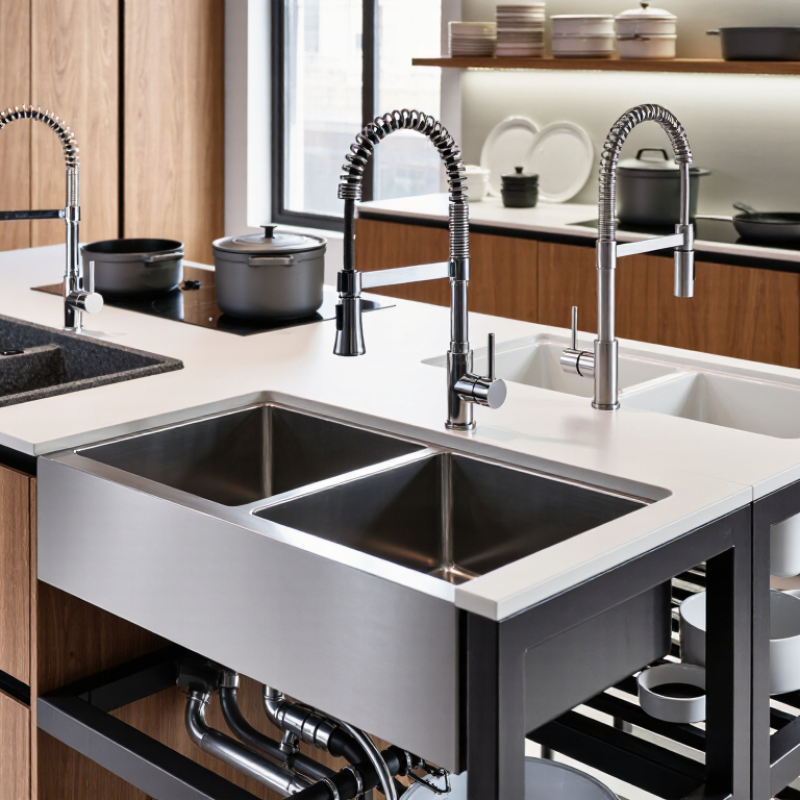
Equal-bowl undermount sinks offer balanced space for everyday cooking. Offset-bowl designs provide one deep basin for pans and one smaller basin for rinsing. Low-divider models allow large cookware to slide across both bowls. High-divider models reduce splashing between tasks. Top-mount versions install easily and can suit renovation projects with uneven counter edges.

Apron-front double bowls create a strong visual focus in traditional kitchens. Corner double bowls use awkward spaces efficiently, although replacement may be difficult. Workstation double bowls add ledges for colanders, boards, or drying racks. Small-bowl and deep-bowl combinations help users wash vegetables beside tall pots. Double bowls with integrated drainboards protect nearby counters from standing water.

Material thickness affects noise, vibration, and long-term durability. Rounded internal corners make cleaning easier. A 60/40 layout may feel practical, but some users dislike losing washing space. I have seen buyers choose deep bowls, then struggle with low cabinets and poor posture. That mistake deserves more attention.

Test bowl depth with your largest cookware before ordering. A sink can look impressive online and still feel cramped in daily use.

Materials, Finishes, and Manufacturing Options

Double-bowl kitchen sinks vary in material, finish, and production method. Equal bowls suit balanced washing, while offset bowls create space for large pans. Low-divider designs offer flexibility but may splash more. For global buyers, 304 stainless steel remains a practical choice because it resists corrosion and handles daily impact. World Stainless reported 58.4 million tonnes of global crude stainless steel production in 2023, supporting its broad industrial availability.

Finishes change both appearance and maintenance. Brushed surfaces hide light scratches better than mirror finishes. PVD coatings can create darker colors, but quality depends on coating thickness and adhesion. Fireclay and granite composite offer visual weight, although transport damage and color consistency need careful control. Undermount installation gives a clean countertop edge. Topmount models simplify replacement. Hand-welded sinks can provide deeper bowls and custom dimensions, yet weld quality must be inspected closely. I have seen attractive samples fail because corners were too sharp. That matters.

Tips: Ask for steel grade, thickness, bowl depth, sound insulation, and drainage testing. Request salt-spray or corrosion-test evidence when choosing coated surfaces. Check whether dimensions match local cabinet standards. EN 13310 and relevant ASTM testing references can improve supplier comparisons, but certificates alone are not enough. Inspect welds, polishing lines, overflow openings, and protective packaging. A cheaper sink may still cost more after installation problems.

Installation Styles, Dimensions, and Plumbing Requirements

Top 10 Kitchen Sink Double Bowl Types for Global Buyers

Installation styles, dimensions, and plumbing requirements determine whether a double bowl sink performs well. The Houzz 2024 U.S. Kitchen Trends Study reports that undermount sinks remain the leading choice in renovated kitchens, with about two-thirds of homeowners selecting them. Top-mount models still suit quick replacements. Farmhouse sinks need a reinforced cabinet front. Flush-fit designs demand accurate countertop cutting. Small apartment kitchens often use 760-millimeter sinks, while larger layouts commonly accept 800 to 900 millimeters. Bowl depths usually range from 200 to 230 millimeters.

Measure the cabinet first. A 900-millimeter sink cabinet is commonly required for many full-size double bowls, but manufacturer tolerances differ. Equal bowls support washing and rinsing. Unequal bowls give better space for baking trays. Low-divide models feel more flexible, though splashing can increase. The NKBA Kitchen Planning Guidelines recommend practical clearances around preparation and cleaning zones, yet real homes rarely match ideal drawings. That is worth admitting.

Undermount installation places the rim below the countertop and requires sealed stone or solid-surface edges. Top-mount installation tolerates more countertop materials and simpler replacement work. Plumbing usually needs two basket strainers connected to one waste outlet, a shared trap, and a vented drain system. Many regions use 40 or 50 millimeter waste pipes, but local codes control the final size. Check the trap height before ordering. A deep bowl can leave too little room beneath the cabinet. Misjudging this detail is surprisingly common.

Top 10 Kitchen Sink Double Bowl Types for Global Buyers - Installation Styles, Dimensions, and Plumbing Requirements

No. Double-Bowl Sink Type Installation Style Typical Overall Dimensions
(W × D × H)
Minimum Cabinet Width Typical Bowl Configuration Drain Arrangement Plumbing Requirements Best Suited For
1 Equal Double Bowl Top-mount or undermount 760–860 × 480–520 × 200–230 mm
30–34 × 19–20.5 × 8–9 in
800–900 mm
31.5–35.5 in
Two bowls of approximately equal width and depth Two 90 mm or 3.5 in basket drains; optional shared waste outlet Two drain tails connected to a double-bowl waste kit; hot and cold water lines for the faucet; an air gap or high loop where a dishwasher is connected General-purpose washing, rinsing, and food preparation
2 60/40 Double Bowl Top-mount, undermount, or flush-fit 760–860 × 480–520 × 200–230 mm
30–34 × 19–20.5 × 8–9 in
800–900 mm
31.5–35.5 in
One bowl about 60% of the width and one bowl about 40%; depths may be equal or slightly different Two 90 mm or 3.5 in drains, normally joined below the sink Double-bowl waste assembly with adequate cabinet clearance; separate hot and cold supply lines; dishwasher connection to the waste or disposer branch if required Homes needing a larger primary washing bowl and a smaller rinsing bowl
3 Low-Divider Double Bowl Undermount or top-mount 760–900 × 480–530 × 200–230 mm
30–35.5 × 19–21 × 8–9 in
800–900 mm
31.5–35.5 in
Two bowls separated by a divider typically 100–150 mm below the rim Two standard 90 mm or 3.5 in drains Double-bowl waste kit; the lower divider does not remove the need for two drain connections; provide sufficient space for the trap and dishwasher branch Users who want double-bowl functions while sliding large cookware across the divider
4 Deep Double Bowl Undermount or top-mount 760–860 × 500–550 × 230–280 mm
30–34 × 19.5–21.5 × 9–11 in
800–900 mm
31.5–35.5 in
Two bowls deeper than approximately 230 mm, often equal or 60/40 Two 90 mm or 3.5 in drains; rear-positioned drains are common Verify that the sink depth does not interfere with the cabinet base, waste trap, or garbage disposer; use a compact trap or revised waste height where necessary Frequent cooking and washing of large pots, baking trays, and tall cookware
5 Workstation Double Bowl Usually undermount or top-mount with accessory ledges 800–1000 × 500–550 × 200–240 mm
31.5–39.5 × 19.5–21.5 × 8–9.5 in
900–1000 mm
35.5–39.5 in
Two bowls with integrated ledges for colanders, grids, cutting boards, or drain racks Two 90 mm or 3.5 in drains; drain position must not conflict with accessory rails Standard double-bowl waste connection; plan clearance for accessories, faucet hoses, water filters, and dishwasher lines inside the cabinet Compact kitchens requiring preparation, washing, and draining functions in one location
6 Apron-Front Double Bowl Farmhouse or apron-front installation 760–900 × 500–550 × 220–280 mm
30–35.5 × 19.5–21.5 × 8.5–11 in
Custom apron-front cabinet, usually 800–1000 mm
31.5–39.5 in
Equal or 60/40 bowls with an exposed front panel Two 90 mm or 3.5 in drains; rear drains can improve storage space Cabinet front must be modified or purpose-built; confirm drain and trap positions before installation; provide flexible supply and waste connections if cabinet movement is limited Traditional or contemporary kitchens designed around a visible sink front
7 Radius-Corner Double Bowl Top-mount, undermount, or flush-fit 760–860 × 480–520 × 200–230 mm
30–34 × 19–20.5 × 8–9 in
800–900 mm
31.5–35.5 in
Two bowls with rounded internal corners, commonly equal or 60/40 Two 90 mm or 3.5 in drains Conventional double-bowl waste kit; rounded corners do not change water-supply requirements, but the cutout must match the manufacturer’s corner radius Easy-clean designs and modern kitchens where softer internal corners are preferred
8 Zero-Radius Double Bowl Usually undermount or top-mount 760–900 × 480–520 × 200–230 mm
30–35.5 × 19–20.5 × 8–9 in
800–900 mm
31.5–35.5 in
Two sharply squared bowls, typically equal or 60/40 Two 90 mm or 3.5 in drains Standard double-bowl waste and trap arrangement; use accurate countertop fabrication because tight corners require precise cutout dimensions Minimalist, contemporary kitchens and commercial-style interiors
9 Compact Double Bowl Top-mount or undermount 600–750 × 450–500 × 180–220 mm
23.5–29.5 × 17.5–19.5 × 7–8.5 in
600–800 mm
23.5–31.5 in
Two smaller bowls, often equal width or a narrow 60/40 layout Two 90 mm or 3.5 in drains; smaller waste kits may be available for regional standards Two drain outlets joined to one branch connection; check trap depth and pipe alignment carefully because compact cabinets provide limited working space Apartments, galley kitchens, utility rooms, and smaller residential projects
10 Reversible Double Bowl with Rear Drains Top-mount or undermount, depending on the rim and cutout 760–900 × 480–530 × 200–240 mm
30–35.5 × 19–21 × 8–9.5 in
800–900 mm
31.5–35.5 in
Equal or 60/40 bowls with a symmetrical layout that can be oriented left or right Two rear-positioned 90 mm or 3.5 in drains Double-bowl waste kit with rear drain alignment; confirm the distance to the wall waste outlet and allow room for a dishwasher hose or food-waste disposer Renovation projects where flexible bowl orientation and increased cabinet storage are important

How to Compare Double Bowl Sinks for Different Markets

Comparing double bowl sinks across global markets requires more than counting basins. Local kitchens differ in cabinet sizes, cooking habits, water pressure, and installation methods. A buyer may choose equal bowls for balanced washing, or unequal bowls for large cookware and easier rinsing. Low-divider models improve flexibility, while deep bowls reduce splashing. Measure twice.

The ten common choices include equal bowl, unequal bowl, low-divider, deep bowl, workstation, farmhouse, undermount, topmount, corner, and compact bar sinks. Each type solves a different problem. Workstation sinks suit busy kitchens with sliding accessories. Farmhouse designs need strong cabinet support. Undermount sinks offer clean edges but demand accurate countertop cutting. Topmount installation is often simpler for replacement projects. Test the depth.

Material comparison also matters. Stainless steel is practical, light, and widely accepted, but thin sheets can sound loud or dent. Granite composite feels solid, although its weight may require reinforced cabinetry. Ceramic surfaces look distinctive but can chip after hard impact. Drain position, bowl radius, overflow design, and included waste fittings should be checked carefully. Regional plumbing connections may not match. Confirm them before purchase.

In my sourcing experience, buyers sometimes focus on appearance and overlook maintenance access. That mistake becomes expensive after installation. I also find that “universal” dimensions are rarely universal. A sink that performs well in one apartment may waste valuable counter space elsewhere. Compare measured drawings, installation instructions, surface durability, and after-sales documentation from qualified suppliers. Leave room for doubt. Test real use, not only photographs.

No products in the cart.