China Top 10 Reed Diffuser Manufacturers for Global Buyers
A Reed Diffuser can make a hotel lobby feel calm, soften a boutique’s first impression, or add a quiet note to a living room. For global buyers, choosing a manufacturer is about more than fragrance. It also means checking how consistently the supplier blends scents, finishes glass vessels, packs orders, and communicates during production. A polished sample is useful. Repeatable results matter more.
Perfumer Jean-Paul Guerlain is often credited with the line, “Perfume is the most intense form of memory.” It captures why scent deserves careful attention, though a diffuser must perform well beyond its first impression. A beautiful fragrance that fades quickly is not enough. Buyers should ask about reed materials, fragrance options, product testing, packaging, and sample-to-batch consistency. Look closely at the details: a stopper that seals cleanly, labels placed evenly, and reeds that draw fragrance steadily. Small things count.
This guide introduces ten Chinese Reed Diffuser manufacturers for international buyers. It is intended as a starting point, not a substitute for direct checks. Compare product specifications, request current samples, and clarify production capacity and lead times before placing an order. No list can capture every factory’s day-to-day performance. That uncertainty matters, and it deserves honest attention. A supplier may look strong on paper yet communicate poorly when an order changes. The right choice depends on your fragrance brief, target market, budget, and expectations for service. Choose with evidence, not just a glossy catalogue.
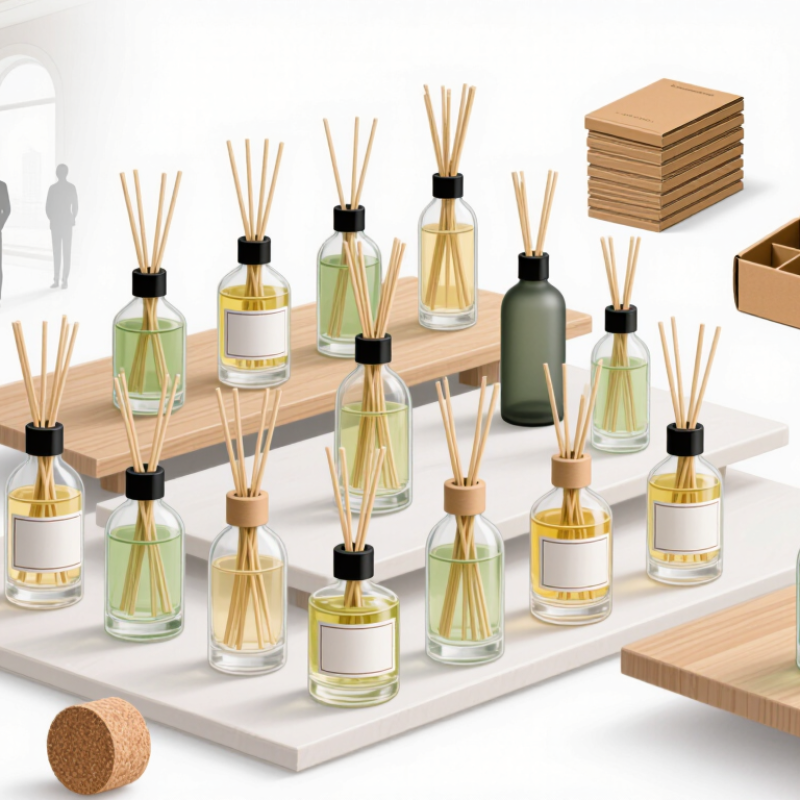
What Reed Diffusers Are and Why Global Buyers Source Them from China
A reed diffuser is a passive home-fragrance system: porous reeds draw scented liquid from a vessel and release its aroma into the air. There is no flame, plug, or moving part. A bottle on a hallway console can provide a steady, subtle scent, though room size, airflow, and reed count affect the result. It is not instant; fragrance usually builds gradually. Turning reeds may strengthen the scent, but can also shorten product life.
Demand reflects a wider interest in home fragrance. Grand View Research estimated the global home-fragrance market at about US$9.2 billion in 2023, with projected annual growth of 4.8% from 2024 to 2030. This figure covers more than reed diffusers, so it should not be read as diffuser-only sales. China attracts global buyers through its established capabilities in glass, packaging, fragrance blending, and contract manufacturing. Buyers can compare bottle capacity, reed material, liquid color, and carton protection in one sourcing process. Small details matter. Ask suppliers for sample testing and clear specifications; a diffuser that smells balanced in a showroom may perform differently in a large, air-conditioned room. Lower prices alone do not guarantee consistent fragrance or reliable delivery.
How to Evaluate Chinese Reed Diffuser Manufacturers
When evaluating Chinese reed diffuser manufacturers, look beyond polished catalogs and low quotations. Grand View Research estimated the global home fragrance market at USD 9.2 billion in 2022, with projected growth of 4.8% annually from 2023 to 2030. The category includes products beyond reed diffusers, so this figure signals broader demand—not a supplier’s performance.
Ask for a sample made with the same fragrance base, reeds, and vessel planned for production. Check whether the liquid clouds, leaks, or fades quickly; test it in a real room, not only a showroom. Request batch records, safety data sheets, and documentation supporting fragrance-standard compliance. Compare evaporation over several weeks. A pleasant first-day scent can be misleading.
Verify production capacity, quality checks, lead times, and export packaging with specific records, then confirm details during a video or factory audit. A small pilot order can reveal inconsistent reed thickness or uneven filling before a larger commitment. Numbers help. They do not decide. Even a careful review has limits: one sample cannot prove every future batch will match.
Comparing Product Ranges, Production Capacity, and Quality Standards
Comparing reed diffuser manufacturers requires more than counting fragrance options. A useful range includes several bottle sizes, reed materials, refill formats, and scent strengths, while keeping components compatible. Ask for samples in the exact bottle and reed combination; a fragrance that performs well in a small vessel may diffuse differently in a wider one. Small details matter.
Market figures provide context, not a supplier scorecard. Grand View Research estimated the global home-fragrance market at USD 22.89 billion in 2023, with projected annual growth of 5.9% from 2024 to 2030. IMARC Group estimated USD 13.3 billion for 2023 and forecast USD 20.8 billion by 2032. Their figures differ, partly because market definitions vary. Neither measures reed diffusers alone.
For production capacity, request documented monthly output, typical lead times, minimum order quantities, and evidence of batch traceability. A quoted maximum can be misleading if it assumes one bottle style or full, steady shifts. Check quality systems and ask for current safety data sheets, batch specifications, and stability or packaging-compatibility test results. IFRA Standards offer guidance for fragrance use, but a supplier’s claim alone does not prove finished-product quality. Even careful audits can miss a weak point; test a pilot batch before committing to a large order.
How to Verify Suppliers and Place an International Order
A reliable reed diffuser supplier should be easy to verify, not just persuasive in a catalog. Request a business registration record, factory or workshop address, and recent product photos. Ask who handles fragrance blending, filling, and final inspection. Clear answers matter. A polished sample can still differ from a large production run, so confirm that the approved sample will be the reference for bulk goods.
Before placing an international order, request a written quotation with unit price, minimum quantity, lead time, payment schedule, and shipping terms. Confirm bottle capacity, reed material, fragrance options, carton dimensions, and labeling details in writing. Ask for a pre-shipment inspection plan and photos of packed cartons. Check that the supplier can provide the export and product documents required by your destination market. Freight costs and customs handling can change the final price; request a landed-cost estimate where possible. Small details are easy to miss.
Tips: Start with a modest trial order. Compare the delivered goods with the approved sample, including scent strength, cap fit, and leakage after a short transport test. Keep payment records and order changes in one email thread. If a detail feels unclear, pause and ask again. I would, too.