
Bird Control Spikes have become a practical choice for protecting warehouses, historic buildings, solar panels, and transport facilities from persistent bird activity. Global buyers now expect more than a low purchase price. They need durable materials, humane design, clear installation guidance, and reliable supplier support.
Market evidence supports this growing attention. MarketsandMarkets estimates that the global pest control market may increase from about USD 19.8 billion in 2023 to USD 27.1 billion by 2028. Its projected compound annual growth rate is approximately 6.5%. Grand View Research also identifies commercial and industrial facilities as important users of pest management solutions. These reports do not measure Bird Control Spikes alone. That limitation matters. Still, they reflect broader demand for preventive property protection and non-lethal control methods.
Dr. John Marzluff, a leading urban-bird researcher, has stated, “Birds are remarkably adaptable.” That observation explains why weak barriers often fail. Effective products must resist weather, ultraviolet exposure, nesting pressure, and repeated landing attempts. For global buyers, comparing manufacturers requires careful attention to spike spacing, stainless-steel grade, polycarbonate stability, mounting options, and documented field experience. Independent testing is valuable, but supplier claims should never be accepted blindly. The best manufacturers explain where their products work, where they do not, and how installation conditions affect performance. This guide reviews leading Bird Control Spikes manufacturers through those practical and professional standards. Some rankings may remain debatable, because regional climate, building design, and bird species can change the result.
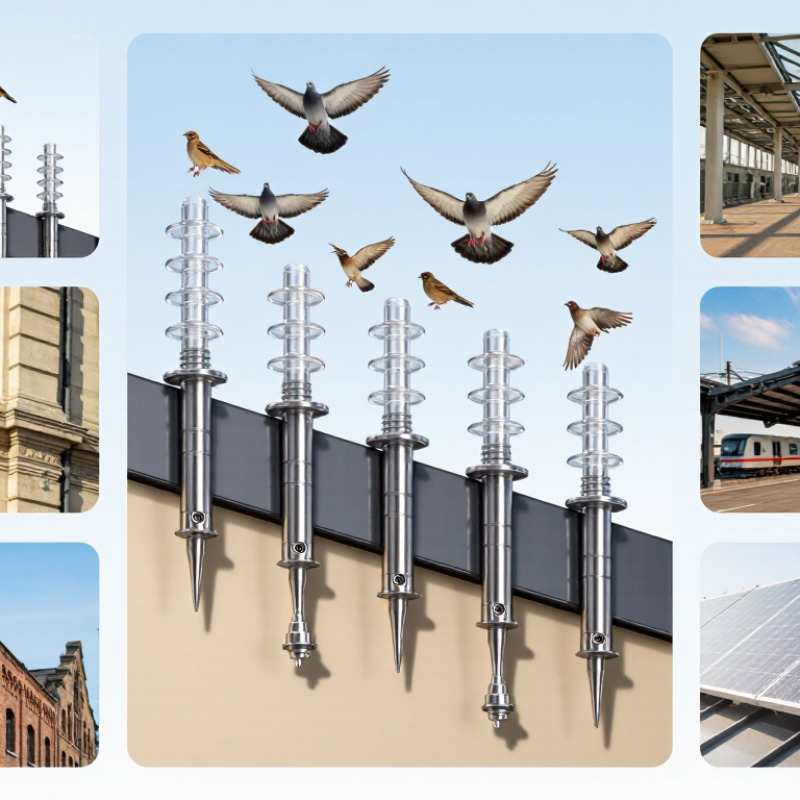
What Bird Control Spikes Are and How They Work
Bird control spikes are passive exclusion devices fixed to ledges, beams, signs, and roof edges. Their narrow, angled wires make landing uncomfortable without trapping or injuring birds. Most systems use stainless steel pins, a flexible base, and weather-resistant adhesive or screws. The objective is simple: remove a usable landing surface.
The FAA’s 2023 Wildlife Strike Report recorded 19,444 reported wildlife strikes involving civil aircraft in the United States. Birds represented the overwhelming majority of these incidents. This data does not measure building damage directly, but it shows why controlled bird movement matters near airports, warehouses, and transport facilities. Properly installed spikes can reduce roosting, droppings, nesting material, and repeated cleaning around vulnerable surfaces.
Performance depends on more than the spike itself. Installers should measure ledge depth, identify bird species, and close gaps at corners and ends. A small uncovered section can become the preferred landing point. Research-based wildlife management guidance from USDA APHIS also supports habitat modification and exclusion as practical control methods. Adhesive alone may fail on dusty stone or wet metal. Fixings need inspection after storms, cleaning, and seasonal nesting pressure. That sounds simple, but field results are rarely perfect. Birds adapt. So should the inspection plan. Global buyers should request corrosion data, load testing, installation guidance, and evidence that materials suit the local climate.
Bird control spikes are rows of blunt, closely spaced stainless-steel or UV-stabilized plastic rods fixed to a base strip. They are installed on ledges, signs, beams, roof edges, and other landing surfaces.
The rods reduce the usable landing area and make stable perching or nesting difficult. Properly selected spikes deter birds without relying on electricity, chemicals, or trapping.
Global buyers should compare target species, ledge width, weather exposure, attachment method, material durability, local wildlife regulations, and installation quality.
Chart data shows approximate representative adult body mass for common urban birds, based on commonly reported field-guide ranges. Values are not manufacturer or brand data.
Bird control spikes vary by site, bird size, surface width, and weather exposure. Stainless steel spikes suit exposed roofs, warehouse ledges, and coastal buildings. Their corrosion resistance supports long service, but correct grade selection still matters. Polycarbonate spikes work well on signs, balconies, and narrow architectural edges. They are lighter and less visible. Wide-base models cover broad parapets, while narrow-base designs fit window sills and slim beams. Angled or multi-row systems can protect deeper ledges from persistent landing attempts.
Solar panels need low-profile spikes that avoid blocking drainage or creating cleaning hazards. Historic façades often require discreet, reversible fittings and careful substrate checks.
Large birds may need stronger, wider systems with closer spacing. Smaller birds can exploit gaps between standard rows. Field inspections show that poor measurement causes many failures. I have seen effective products underperform because dust, nesting material, or loose adhesive weakened the installation. Fixings must match concrete, stone, metal, or masonry.
Tips:
Top Bird Control Spikes Manufacturers for Global Buyers
When comparing bird spike manufacturers, start with evidence, not polished photographs. Ask how long the factory has produced bird deterrent systems. Experienced suppliers should explain material choices, testing methods, and installation limits clearly. Request stainless steel grades, base dimensions, spike height, and adhesive specifications. A reliable manufacturer can provide batch numbers, technical drawings, and clear inspection records.
Examine samples under practical conditions. Press the base against a flat surface and check for gaps, sharp edges, or weak bonding. Flexible bases should recover after bending without cracking. Metal spikes need consistent spacing and firm attachment. Ask for tests involving ultraviolet exposure, moisture, salt spray, and temperature changes. Independent laboratory reports carry more weight than vague claims. However, certificates can become outdated, so verify their issue dates and testing scope.
Production quality also depends on packaging and support. Good suppliers protect spikes from deformation during long-distance shipping. Their instructions should show roof edges, ledges, signs, and drainage areas. Ask whether the supplier reviews site conditions before recommending a model. One product rarely suits every surface. A low-cost sample may look acceptable, yet fail after repeated heat and rain. I once overlooked adhesive compatibility during a product review; the installation appeared neat but loosened later. That mistake remains useful. It shows why factory claims should be checked against field trials, not accepted too quickly.
| Assessment Dimension | What Global Buyers Should Check | Typical Quality Benchmark | Recommended Evidence | Priority |
|---|---|---|---|---|
| Spike Material | Confirm the metal grade, mechanical strength, surface finish, and suitability for the installation environment. | Stainless-steel spikes commonly use grades such as 304 for general outdoor use or 316 where chloride and coastal exposure are significant. | Material certificate, mill test report, and independent material verification when required. | Critical |
| Base Material | Review resistance to sunlight, temperature changes, impact, and brittleness during installation. | Outdoor-grade polycarbonate or another UV-stabilized polymer with consistent molding and no visible cracking, warping, or excessive flash. | Polymer specification, UV-stabilizer declaration, production samples, and accelerated-weathering results if applicable. | Critical |
| Spike Geometry | Compare spike height, coverage width, spacing, angle, and flexibility with the target bird species and ledge dimensions. | Common commercial configurations cover approximately 100–200 mm per row, with several height options for narrow ledges and larger roosting birds. | Dimensioned drawings, product samples, and a coverage calculation for the project site. | Critical |
| Wire Diameter and Form | Check uniform diameter, smooth bends, secure anchoring, and the absence of sharp manufacturing burrs. | The wire should retain its designed shape under normal handling and should be firmly fixed to the base without loose or misaligned sections. | Incoming-material records, dimensional inspection reports, and random sample inspection. | High |
| Corrosion Resistance | Assess performance in coastal, industrial, humid, or polluted environments rather than relying only on a generic corrosion claim. | Stainless steel should show no significant red-rust formation under the agreed test conditions; test duration should be selected according to the project risk. | Laboratory corrosion report, test method, exposure duration, photographs, and acceptance criteria. | Critical |
| UV and Weathering Performance | Verify whether the base remains stable after prolonged sunlight and outdoor temperature cycling. | No substantial cracking, severe discoloration, deformation, or loss of attachment strength after the specified weathering program. | Accelerated-weathering report, outdoor exposure data, and warranty terms linked to installation conditions. | High |
| Base Adhesion and Fixing | Determine whether the system uses adhesive, screws, clips, or a combined method and whether it matches the substrate. | The fixing method should be specified for concrete, masonry, metal, stone, glass, or other common substrates; adhesive performance must account for clean, dry surfaces and temperature. | Installation manual, substrate compatibility chart, adhesive technical data sheet, and pull-off or adhesion test results where applicable. | Critical |
| Manufacturing Consistency | Review how the manufacturer controls dimensions, assembly, surface finish, and batch-to-batch variation. | Documented incoming inspection, in-process checks, final inspection, traceable batch records, and a defined nonconforming-product process. | Quality manual, inspection plan, sample inspection report, corrective-action records, and factory audit findings. | High |
| Bird-Control Effectiveness | Confirm that the design prevents landing and roosting without causing unnecessary injury or creating a maintenance hazard. | The selected configuration should cover the full usable ledge, leave no significant gaps, and be appropriate for the bird size and pressure identified in the site survey. | Site survey, layout plan, installation photographs, project references, and post-installation monitoring records. | Critical |
| Safety and Regulatory Documentation | Check local rules for wildlife protection, façade work, access equipment, and safe installation practices. | Clear handling instructions, risk information, installation limitations, and documentation supporting legal use in the destination market. | Safety data, technical manual, declaration of conformity where applicable, and local regulatory review. | Critical |
| Packaging and Export Protection | Evaluate protection against crushing, moisture, contamination, and deformation during international transport. | Rigidly packed components, moisture-resistant outer packaging, clear carton identification, and packaging dimensions suitable for palletization. | Packaging specification, drop or handling-test records, loading photographs, and shipping damage history. | Medium |
| Traceability and Warranty | Confirm how defects are traced and what conditions, exclusions, and remedies apply after delivery. | Each shipment should be linked to a production batch, inspection record, and written warranty covering material and manufacturing defects. | Batch labels, warranty document, complaint procedure, replacement policy, and service-response targets. | High |
| Supply Capacity and Lead Time | Assess production capacity, minimum order quantity, replenishment reliability, and the ability to support repeat projects. | A documented production schedule, realistic lead-time commitment, reserve capacity, and clear communication of material or tooling constraints. | Capacity statement, production plan, historical delivery records, and agreed order milestones. | High |
| Technical Support | Check whether the supplier can support site surveys, product selection, drawings, installation training, and after-sales troubleshooting. | Written installation guidance, responsive technical communication, and project-specific recommendations rather than only a standard catalogue. | Technical contact details, sample project documentation, response-time records, and installation training materials. | Medium |
Global buyers need bird control spikes manufacturers that understand different building styles, climates, and purchasing requirements. Reliable manufacturers usually provide stainless steel or UV-stabilized materials for long-term outdoor use. Material quality matters near coastlines, where salt air can accelerate corrosion. Ask for technical data, batch records, and clear installation instructions before placing a large order.
Good manufacturers also test spike strength, adhesive compatibility, and resistance to temperature changes. Their teams should explain spacing, surface preparation, and safe placement around ledges, signs, and roof edges. Practical experience is valuable here. A product may look effective in a catalog but perform poorly on dusty concrete or uneven stone. That detail is easy to overlook.
Global buyers should review export packaging, inspection procedures, replacement policies, and response times. Product samples can reveal sharp edges, weak bases, or inconsistent finishing. However, samples do not show everything. Long-term field feedback is still necessary. I would also question unusually low prices, because thinner materials can create maintenance problems later. Some manufacturers offer custom lengths and mounting options, but customization needs careful drawings and measurements. Regional building rules may also affect installation methods, especially near public walkways. Clear documentation builds trust, although no supplier communicates perfectly every time. Mistakes happen. The better manufacturers acknowledge them quickly and improve their process.
For global buyers, selecting a bird control spikes manufacturer involves more than comparing unit prices. Ask for material certificates, production photos, dimensional drawings, and test data for wind, corrosion, and UV exposure. Stainless steel grades should match the building environment, especially coastal roofs with salt spray. Request samples before placing a large order. A catalog can look precise. The product may still feel flimsy.
International purchasing also depends on export readiness. Confirm packaging dimensions, carton markings, customs codes, certificates of origin, and agreed delivery terms in writing. Clarify whether the supplier supports replacement parts and installation guidance after arrival. Use a pre-shipment inspection for large projects. Check spike spacing, base adhesion, and carton damage. One overlooked detail can delay an entire container. I would not rely on photographs alone.
Installation must suit the surface, bird species, and local building rules. Metal roofs, masonry ledges, and historic façades need different fixing methods. Adhesives may fail on dusty or wet substrates, while drilling can damage waterproofing. Qualified installers should use safe access equipment and avoid blocking drainage, vents, or maintenance paths. Compliance may include animal-welfare requirements, heritage restrictions, worker-safety rules, and property-owner approval. Local review is essential, even when the product seems standard.
