
How to Choose the Right Axial Duct Fans for Your Needs?

Choosing the right Axial Duct Fans begins with the air problem, not the product catalogue. A fan must move the required airflow through real ductwork, bends, filters, grilles, and dampers. A model that looks powerful on paper may struggle when resistance increases. That mistake is surprisingly common.

Dr. William P. Bahnfleth, a respected ASHRAE ventilation researcher, offers a useful reminder: “Ventilation is not a magic bullet.” His point applies directly to fan selection. Axial Duct Fans can support effective air movement, but they cannot correct poor duct design, blocked outlets, or inadequate maintenance. The complete system matters.

This guide examines the decisions that deserve careful attention. You will consider airflow volume, static pressure, noise, motor efficiency, installation space, temperature, and control requirements. A warehouse may need high-volume extraction near the roof. A commercial kitchen may demand stronger pressure performance and grease-resistant construction. A small workshop might need quieter operation beside occupied workstations.

Measure the duct route.

Do not guess.

Real-world experience also exposes uncomfortable details. Manufacturer performance data may use ideal test conditions. Your installation will rarely be ideal. Dust can build on blades. Dampers may remain partly closed. Electrical supply can limit motor selection. These details can change results.

The best choice balances performance, energy use, durability, and service access. It may not be the largest fan. It may not be the cheapest one. Careful selection creates dependable ventilation, safer operation, and fewer expensive adjustments after installation.
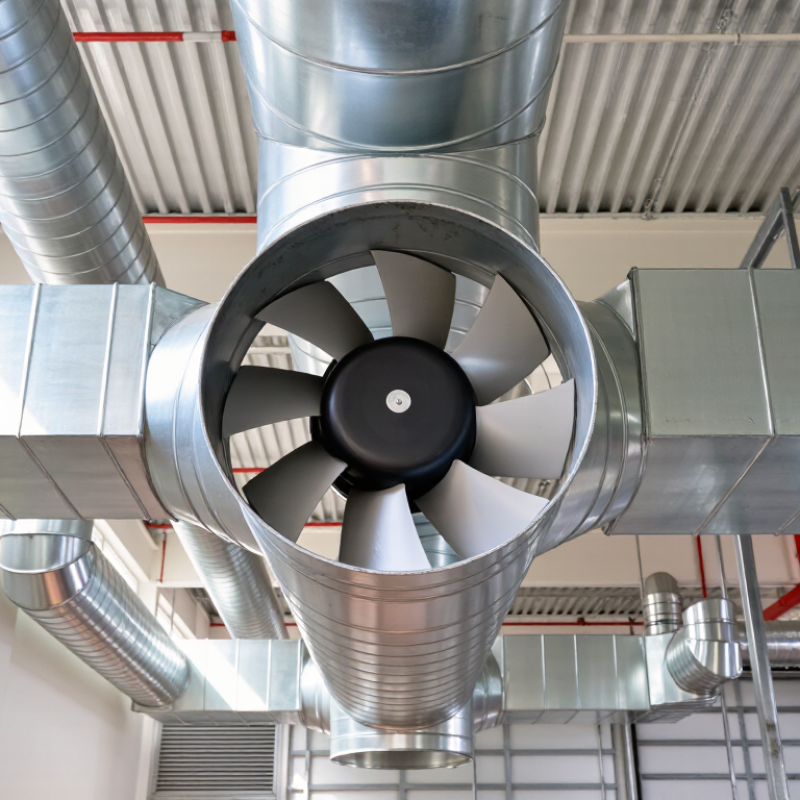
How to Choose the Right Axial Duct Fans for Your Needs?

Define Required Airflow and Static Pressure in CFM and Pa Using AMCA 210

How to Choose the Right Axial Duct Fans for Your Needs?

Start with airflow, not fan size. Calculate required airflow in CFM from room volume and air changes per hour.

For example, a 1,200-cubic-foot room requiring six air changes needs about 120 CFM.

This figure describes volume movement, not resistance. Static pressure, measured in pascals, represents the resistance created by ducts, filters, grilles, dampers, and bends.

List every pressure loss in the system. Then add a reasonable safety margin, usually 10–15%, without over-sizing the fan.

The U.S. Department of Energy’s Improving Fan System Performance sourcebook reports that fan systems can represent roughly 10–20% of industrial electricity consumption. Efficient selection matters. Excessive pressure capacity can increase noise and energy use.

Use AMCA 210 test data when comparing axial duct fans. The standard defines laboratory methods for measuring airflow, pressure, power, and efficiency under controlled conditions.

Match the required operating point, such as 120 CFM at 180 Pa, with the published performance curve.

Do not compare free-air airflow with tested system airflow. That mistake is common.

In real installations, my first pressure estimate is often too optimistic. A dusty filter or undersized grille can change the result quickly. ASHRAE Handbook guidance also supports evaluating the complete air-distribution system, rather than selecting a fan from airflow alone.

Set Duct Air Velocity Targets with ASHRAE’s 2–10 m/s Design Range

How to Choose the Right Axial Duct Fans for Your Needs?

Choosing an axial duct fan starts with a clear air velocity target. ASHRAE’s commonly referenced design range is about 2–10 m/s for duct airflow. Lower velocities can reduce noise and energy use. Higher velocities may suit compact systems, but they often increase pressure loss and sound.

Measure the duct size before selecting the fan. A 400 mm duct carrying air at 5 m/s needs about 0.63 m³/s of airflow. The fan must also overcome resistance from bends, grilles, dampers, filters, and long duct runs. Airflow alone is not enough. Check the fan curve at the required pressure, not only its maximum volume rating.

Keep the target realistic.

In occupied spaces, moderate velocity is often more comfortable. In industrial extraction, a higher target may be necessary to capture heat, dust, or fumes effectively. However, the final choice depends on the contaminant, duct layout, and local safety requirements.

Poorly sealed joints can reduce actual performance. So can an undersized grille.

During commissioning, use a calibrated anemometer at several duct points. Compare measured velocity with the design target. I have found that a neat calculation can still fail in the field. Recheck assumptions when readings vary widely. Fan selection should remain adjustable through speed control, balancing dampers, or a revised duct design.

Compare Axial Fan Types by Pressure Capability and ISO 5801 Test Data

Choosing an axial duct fan starts with pressure, not air volume alone. Propeller fans suit open spaces and short, clean ducts. Their pressure capability is usually limited. Tube axial fans handle longer duct runs and moderate resistance. Vane axial fans add guide vanes, improving pressure recovery and operating efficiency.

ISO 5801 test data makes comparisons more reliable. The standard measures airflow, pressure, power, and efficiency under controlled installation conditions. Check the pressure curve, not only the maximum airflow figure. For example, a fan rated at 12,000 m³/h may deliver far less at 400 Pa. That difference becomes obvious when filters, grilles, bends, and dampers are included. Request data at the actual duty point.

During site selection, I measure duct resistance and inspect the proposed mounting position. A tube axial model may work well at 250 Pa, while a vane axial design may remain stable near 600 Pa. These figures are examples, not universal limits. Actual performance changes with diameter, blade pitch, air density, and system leakage.

Small details matter. Very much.

One common mistake is trusting a catalog curve without checking its test setup. ISO 5801 results improve confidence, but they do not replace field verification. I would compare sound levels, motor reserve, and control range before approving the selection. Sometimes the quieter fan is the better engineering choice, even when its peak airflow looks less impressive.

Apply Fan Laws: Flow ∝ Speed, Pressure ∝ Speed², Power ∝ Speed³

How to Choose the Right Axial Duct Fans for Your Needs?

Apply Fan Laws: Flow ∝ Speed, Pressure ∝ Speed², Power ∝ Speed³

Choosing an axial duct fan starts with the duty point, not the catalogue airflow alone. Measure required airflow, static pressure, duct size, air temperature, and operating hours. Fan laws help predict performance when the same fan runs at a different speed. If speed rises by 10%, airflow rises about 10%, pressure rises about 21%, and power rises about 33%. That last increase is easy to underestimate.

For example, an existing fan delivers 8,000 m³/h at 900 rpm. Raising speed to 1,125 rpm gives a ratio of 1.25. The estimated airflow becomes 10,000 m³/h, while pressure becomes 1.56 times higher. Power may nearly double, reaching 1.95 times the original demand.

Check the motor, controller, bearings, and electrical protection before changing speed. More air is not free.

Use these relationships only when comparing the same fan under similar conditions. Air density changes with temperature and elevation, so hot process air requires correction. System resistance also matters; pressure usually increases with the square of airflow. A fan that appears adequate on paper may stall near filters, grilles, or sharp elbows. Measure actual pressure with a calibrated gauge. Record noise and vibration too. Field data often exposes my first estimate as optimistic. Allowing a modest margin is sensible, but excessive oversizing can waste energy and create uncomfortable noise.

Check Noise, IP Ratings, Motor Duty, and Efficiency Before Final Selection

How to Choose the Right Axial Duct Fans for Your Needs?

Noise should be checked at the occupied area, not only beside the fan. A low decibel rating can still hide an irritating tonal sound. During site inspections, duct vibration often proves louder than the motor itself. Flexible connectors and balanced mounting can reduce this problem.

Listen carefully.

The IP rating must match the installation environment. A damp plant room may require stronger water protection than a clean warehouse. Dust, condensation, and washdown routines should guide the decision. However, a higher rating does not replace proper installation. Cable glands, seals, and drainage still matter.

Motor duty deserves equal attention. Confirm whether the fan runs continuously, intermittently, or under frequent starts. Continuous-duty motors need suitable thermal protection and enough cooling around the housing. Efficiency should be judged at the required airflow and static pressure, not from a headline percentage. Review the fan curve, operating speed, and expected control method.

Variable-speed control may reduce energy use, but poor adjustment can create noise and unstable airflow. This is where selection becomes less tidy. A theoretically efficient fan may perform poorly in a restrictive duct system.

Record actual airflow, sound levels, and motor temperature after commissioning. These measurements can challenge the original specification, which is useful.

No products in the cart.