
Choosing the right barn door involves more than admiring warm oak grain. A well-designed Oak Veneer Acoustic Slatted Barn Door can soften echoes, separate busy rooms, and add architectural character without overwhelming the space. Its narrow timber slats create rhythm, while the veneer offers a more consistent appearance than many solid-wood alternatives.
This guide examines ten notable options through practical criteria. We consider slat spacing, core construction, acoustic backing, track quality, finish durability, sizing, and installation requirements. These details matter in home offices, bedrooms, studios, and meeting spaces. They also affect how the door feels in daily use. A quiet room is not created by the door alone. Wall structure, floor gaps, seals, and surrounding surfaces all influence performance.
Real-world experience reveals trade-offs. A heavier door may feel substantial, yet demand stronger hardware. A darker oak finish can look refined, but may show dust more clearly. Some products promise acoustic improvement without publishing tested ratings. That deserves caution. No ranking is flawless. Preferences, budgets, and room conditions differ.
The selections below are intended as a practical starting point, not a substitute for verified specifications or professional installation advice. We highlight useful strengths and possible weaknesses, including details that product photography often hides. Expect clear comparisons, realistic observations, and a closer look at what makes each option suitable. The best choice should sound quieter, roll smoothly, close securely, and still look right after years of use.
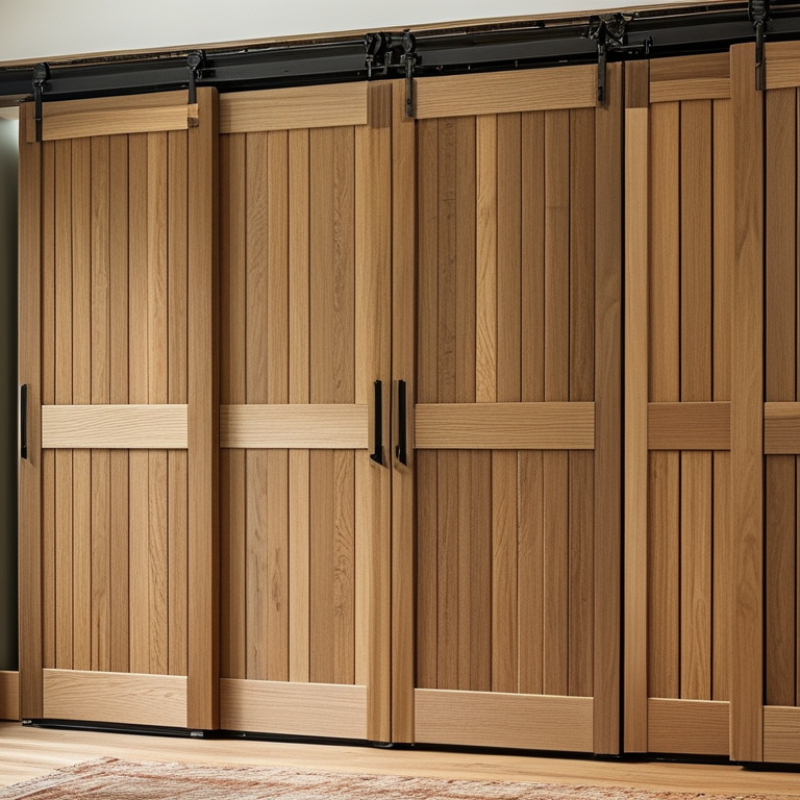
Oak veneer acoustic slatted barn doors combine warm wood appearance with practical sound control. They usually feature a stable engineered core, real oak veneer, and evenly spaced timber slats. Behind the slats, an acoustic backing helps reduce echoes and soften mid-frequency noise.
They are useful for home offices, meeting rooms, studios, and bedrooms. The sliding design saves floor space, but it does not create a fully soundproof room. Sound can still travel around the door edges and beneath the panel. In my experience, a well-fitted seal improves privacy more than decorative slats alone. Check acoustic test data before purchasing, because performance depends on the panel, backing, wall, and installation quality. Veneer can also vary in grain and tone. That natural difference is attractive, but matching two doors may be difficult.
Tips: Measure the opening, wall clearance, and track length carefully. Allow extra space beside the doorway for the panel to slide completely. Use a moisture-stable core in changing indoor climates. Keep the veneer away from direct water and harsh cleaning products. A soft, dry cloth is usually enough. Confirm the door’s weight before selecting hardware. Some installations look simple, yet poor track support can cause vibration, noise, or uneven movement. I would also request a physical sample, since online images rarely show the oak’s true texture.
Oak Veneer Acoustic Slatted Barn Doors: How Oak Veneer and Acoustic Slats Improve Door Performance
Oak veneer gives a barn door a warm, natural surface without the weight of solid oak. Its layered core can improve stability during seasonal humidity changes. That matters in bedrooms, offices, and meeting rooms where door movement creates small but irritating gaps. However, veneer alone does not make a door acoustic. The core, perimeter seals, frame, and sliding hardware control most of the final result.
Acoustic slats help by combining reflective oak faces with recessed sound-absorbing material. The gaps interrupt direct sound reflections, while the backing layer reduces mid-frequency reverberation. The World Health Organization’s Environmental Noise Guidelines for the European Region recommends less than 30 dB(A) inside bedrooms at night. A well-fitted door can support quieter interiors, but it cannot solve every noise problem. Walls and ceiling joints still matter.
Professional testing should follow ASTM E90 for airborne sound transmission and ASTM E413 for Sound Transmission Class ratings. Do not trust a material sample alone. The complete door assembly needs testing. A heavier slab may perform better, yet a poorly sealed sliding barn door can underperform badly. I have found this easy to overlook during design reviews. Acoustic slats also reduce echo, but their visual rhythm may require more cleaning. Real performance depends on installation accuracy, seal compression, track alignment, and the room’s existing construction.
Indicative sound absorption coefficients for a slatted oak-veneer door panel with an acoustic backing layer. Absorption generally increases through the speech-frequency range, helping reduce reverberation and improve acoustic comfort.
Values represent typical engineering reference levels for wood slat acoustic construction and are not a certified laboratory rating for a specific door. Final performance depends on slat spacing, cavity depth, backing material, seals, and installation quality.
When comparing oak veneer acoustic slatted barn doors, look beyond the timber finish. Oak veneer adds warmth, but it does not create sound isolation by itself. The core, door mass, seals, and installation determine performance. ASTM E90 measures airborne sound transmission in laboratories, while ASTM E413 converts results into an STC rating. Ask for both the test method and complete laboratory report. A single marketing number is not enough.
Slatted faces can support absorption, especially when backed by mineral wool or acoustic felt. However, open gaps may reduce privacy if the door perimeter remains unsealed. Compare the door’s tested STC rating, NRC value, thickness, core density, and automatic drop seal. The WHO Environmental Noise Guidelines for the European Region recommend indoor bedroom noise below 30 dB(A) at night. That target is not guaranteed by any barn-door style. Track strength and soft-close control also matter. A heavy door can rattle against a weak wall bracket.
Tips: Place your hand near the jamb while closing the door. Moving air reveals leakage. Check whether the report covers the complete door assembly, not only the panel. In my experience, attractive slats often receive more attention than the bottom gap. That is a mistake worth questioning. Compare oak veneer thickness, repairability, humidity resistance, and fire-rating documentation. Veneer can look premium, yet poor edge sealing may cause visible swelling over time. Personally, I would choose a simpler door with verified testing over a beautiful door with uncertain acoustic claims.
| Rank | Door Configuration | Recommended Opening | Oak Veneer & Slat Detail | Core & Acoustic Infill | Target STC Range | Sealing System | Hardware Load Capacity | Best Use |
|---|---|---|---|---|---|---|---|---|
| 1 | Full-Seal Premium Acoustic Barn Door | Single opening up to 900 × 2100 mm | Natural oak veneer; 27 mm wide slats with 13 mm acoustic gaps | Solid engineered timber core with mineral-fiber acoustic backing | 38–42 dB target | Magnetic jamb seals and automatic drop seal | Up to 120 kg | Bedrooms, studies, and meeting rooms |
| 2 | Double Sliding Acoustic Barn Door | Double opening up to 1800 × 2100 mm | Quarter-cut oak veneer; symmetrical 30 mm slat layout | Layered timber core with recycled PET acoustic layer | 34–38 dB target | Meeting-stile seal, perimeter brush seals, and drop seals | Up to 160 kg total | Wide living rooms and conference spaces |
| 3 | Slimline Home Office Acoustic Door | Single opening up to 850 × 2040 mm | Oak veneer face; 20 mm slats with 12 mm reveal gaps | Medium-density engineered core with PET felt absorber | 32–36 dB target | Side brush seals and adjustable bottom seal | Up to 100 kg | Home offices and study areas |
| 4 | Solid-Core Media Room Door | Single opening up to 950 × 2200 mm | Rift-sawn oak veneer; 35 mm slats for a deeper profile | High-density composite core with acoustic fleece layer | 36–40 dB target | Compression seals on three sides and automatic door bottom | Up to 140 kg | Home theaters and media rooms |
| 5 | Space-Saving Single-Pass Door | Single opening up to 800 × 2000 mm | Oak veneer; 24 mm slats with narrow 10 mm gaps | Engineered timber core with sound-absorbing felt layer | 30–34 dB target | Brush seals and optional threshold seal | Up to 90 kg | Compact apartments and utility rooms |
| 6 | Flush-Back Acoustic Slatted Door | Single opening up to 900 × 2100 mm | Oak veneer slatted front with a plain matching reverse side | Solid-core construction with recycled-fiber acoustic mat | 33–37 dB target | Concealed side seals and drop-down bottom seal | Up to 110 kg | Open-plan interiors requiring a clean reverse face |
| 7 | Warm-Tone Natural Oak Acoustic Door | Single opening up to 850 × 2100 mm | Natural oak veneer; 28 mm slats with visible grain matching | Honeycomb-reinforced timber core with PET acoustic backing | 31–35 dB target | Perimeter brush seals and adjustable sweep seal | Up to 100 kg | Bedrooms and hospitality interiors |
| 8 | Heavy-Duty Commercial Acoustic Door | Single opening up to 1000 × 2400 mm | Durable oak veneer; 40 mm slats with impact-resistant finish | High-density solid core with mineral-wool acoustic layer | 38–42 dB target | Heavy-duty compression seals and automatic drop seal | Up to 180 kg | Studios, offices, and high-traffic commercial spaces |
| 9 | Minimalist Narrow-Slat Door | Single opening up to 800 × 2100 mm | Oak veneer; 18 mm slats with 8 mm regular spacing | Light solid core with acoustic felt and damping layer | 29–33 dB target | Side brush seals; bottom seal recommended | Up to 85 kg | Modern residential interiors and dressing rooms |
| 10 | Budget-Friendly Acoustic Barn Door | Single opening up to 900 × 2100 mm | Oak veneer; 22 mm slats with a standard linear pattern | Engineered core with acoustic felt backing | 28–32 dB target | Basic brush seals; drop seal available as an upgrade | Up to 100 kg | Pantries, laundry rooms, and light-duty partitions |
Choosing the best oak veneer barn door starts with your room’s measurements, not its appearance.
Measure the opening, wall space, ceiling height, and nearby furniture. Allow extra width for comfortable overlap. A door that looks elegant can still block a light switch or scrape against a cabinet.
Oak veneer usually covers an engineered wood core. Ask about veneer thickness, core stability, finish quality, and edge protection. Natural grain should look continuous across the panels, although small color variations are normal.
Acoustic slats can soften echoes, but they do not automatically create soundproofing. Noise control depends on the door’s core, seals, floor gap, and wall construction. Test the sliding movement in person when possible. Listen for rattles. Touch the surface.
Choose strong hardware rated above the door’s actual weight. The track should attach to solid framing, not only plasterboard. A floor guide keeps the panel steady, especially in busy hallways.
Check the wall for uneven areas before installation. Humidity also matters. Oak veneer may react to damp rooms or sudden temperature changes.
My earlier assumption was that heavier doors always reduced noise. In practice, gaps often mattered more.
A quiet room needs careful fitting, not just a beautiful timber surface. Clean the veneer with a soft, slightly damp cloth, and avoid soaking the edges.
Oak veneer acoustic slatted barn doors need careful installation to perform well. In my installation work, I measure the opening, wall structure, and floor level twice. A heavy door needs solid blocking behind the track. Plasterboard alone may flex over time. Leave the door in its room for several days before fitting. This allows the veneer to adjust to local humidity.
Fit the track perfectly level. Even a small slope can make the door drift or scrape. Install the floor guide with enough clearance for smooth movement. Check the gaps around the door, especially near the handle side. Acoustic control depends on these gaps, wall construction, and the door’s internal core. Slatted surfaces can reduce reflections, but they cannot replace proper seals or sound-rated building work. This detail is often misunderstood.
Use a soft, slightly damp cloth for routine cleaning. Never flood the slats or allow water to sit along the veneer edges. A mild, pH-neutral cleaner is safer than strong solvents. Inspect rollers, screws, guides, and handles every few months. Tighten loose hardware gently; overtightening can damage the panel. Keep indoor humidity reasonably stable, ideally around 40–60 percent. Direct sunlight may gradually change the oak tone, so curtains can help. I once ignored a small rubbing sound, and the worn guide became an expensive repair. That was avoidable. Check early. Veneer can also chip at exposed corners, so move furniture carefully and repair small damage before moisture reaches the substrate.
